The challenge
Monipack's customers browse like shoppers but buy like businesses. Before an order, they often need to confirm quantity, packaging unit, bulk price, stock, customisation and delivery. A standard 'add to cart, pay now' store would not reflect that process.
What we did
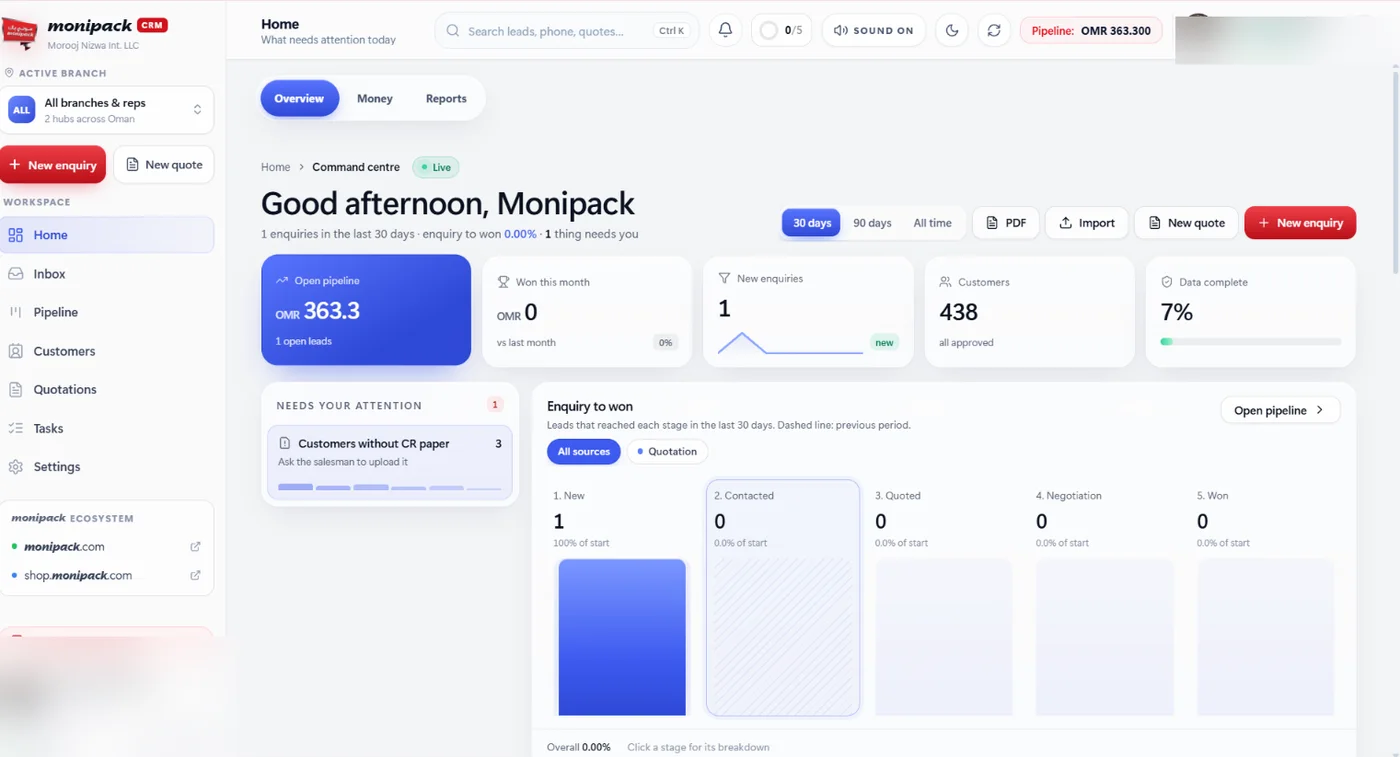
Wahj Growth designed and built a responsive product storefront connected to a secure business dashboard: inquiries, custom requests, quotation PDFs, follow-ups and reporting in one platform, then moved it into Monipack's own independently run hosting. The sales team's CRM is a separate system, covered in its own case study.
Scope of work
- Online storefront and product catalogue
- Inquiry and quotation journey
- Quotation builder with PDF export
- Follow-ups and reporting in the dashboard
- Business dashboard and staff roles
- Production migration to new hosting
Shopping familiarity, business reality
Monipack supplies packaging, food products and cleaning supplies to households, cafés, bakeries, restaurants and companies across Oman, through retail branches and warehouses in Nizwa and Muscat. Its customers expect the ease of an online store: search, categories, product photos. But many purchases need a conversation first. How many cartons? Is it in stock? Can it be printed with our logo? What is the bulk price?
The question Wahj Growth set out to answer was simple: how might we help customers find the right products and explain what they need clearly, while giving the business one place to manage products, inquiries, quotations and follow-ups?
The answer was a platform that looks and feels like a shop, but ends where a business sale really begins: with an inquiry that turns into a quotation.
A typical online store
- Add to cart
- Pay by card
- Order is assumed confirmed
- Price and stock are taken as final
What we built for monipack
- Request a quote or bulk inquiry
- Team confirms price, stock and supply
- Quotation PDF with validity and terms
- Follow-ups tracked to a clear outcome
How an inquiry becomes a quotation
Here is the journey, from a customer's first search to a closed deal. Choose a step to see where it happens.
Storefront · Step 1/6
Find the right product
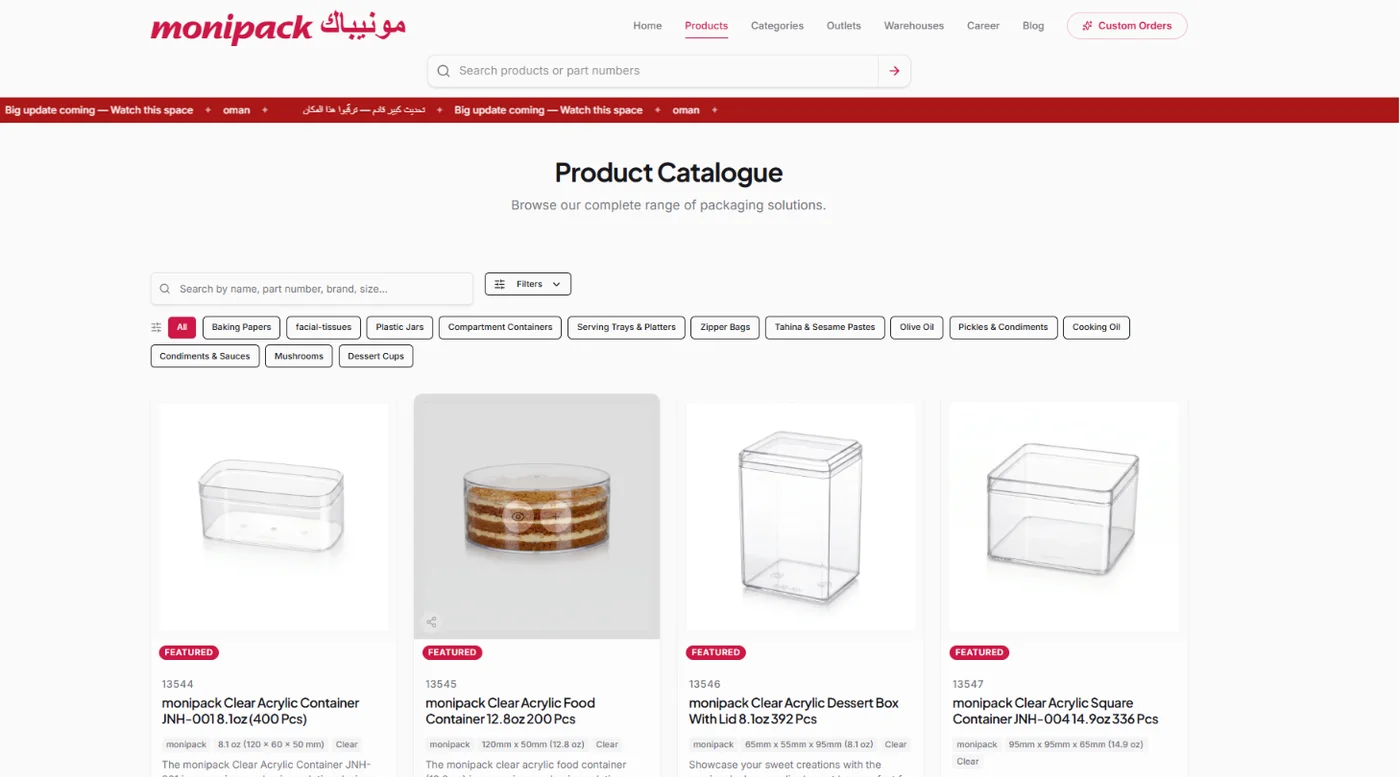
Customers search by name, part number, brand or size, browse categories, and explore collections such as Featured, Best Seller, New Arrival and Customizable.
Storefront · Step 2/6
Check the specifications
Each product shows its part number, size and colour, selling unit, pieces per carton, availability and, where the business chooses, a price for each unit. Approved reviews and ratings add context.
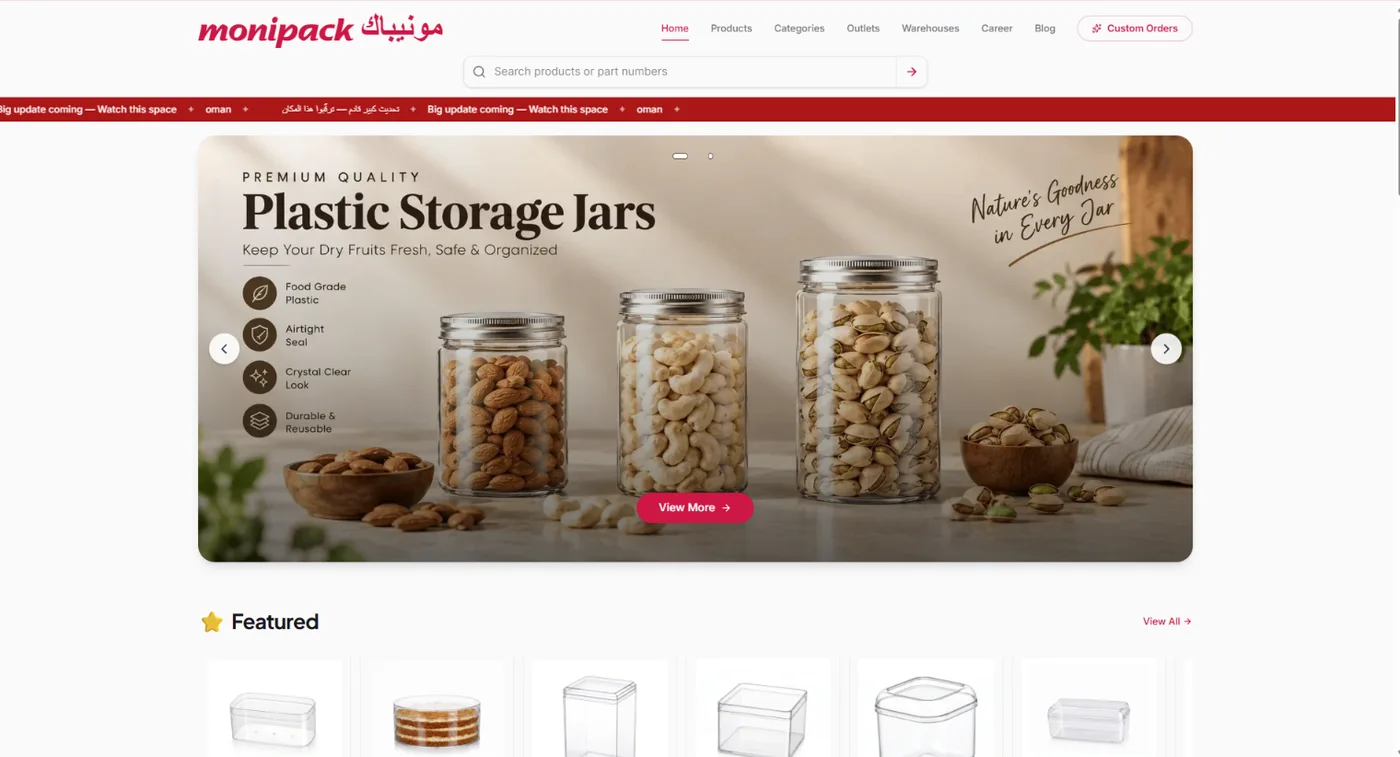
Storefront · Step 3/6
Send an inquiry
Customers request a quote, a bulk quantity, restock or pre-order information, or a custom product with notes and reference images. WhatsApp is one tap away to continue the conversation.
Dashboard · Step 4/6
Turn it into a quotation
The team builds a quotation linked to the inquiry: line items, quantities and units, prices in OMR, optional VAT, validity, terms and custom sections, then produces a PDF with a reference number.
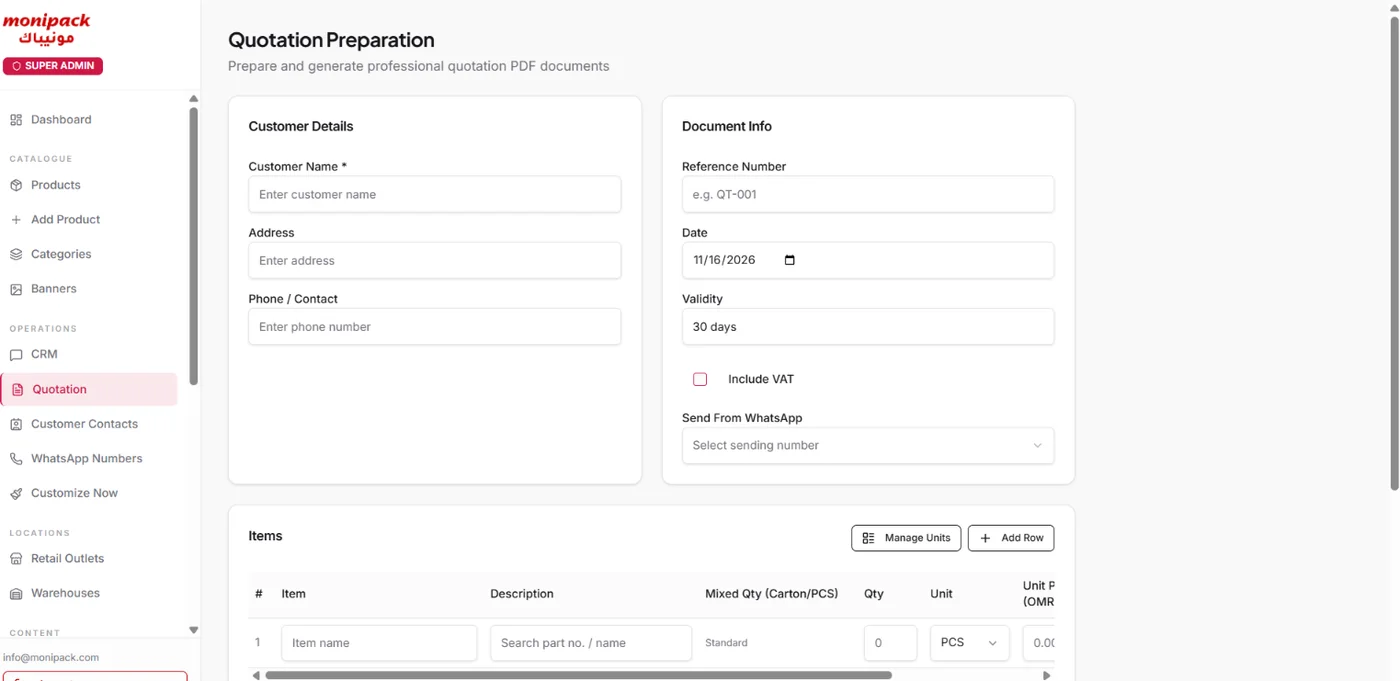
Dashboard · Step 5/6
Follow up on time
Follow-up dates, notes and a timeline for each customer keep every quotation moving. Today's, overdue and upcoming follow-ups are listed in one place.
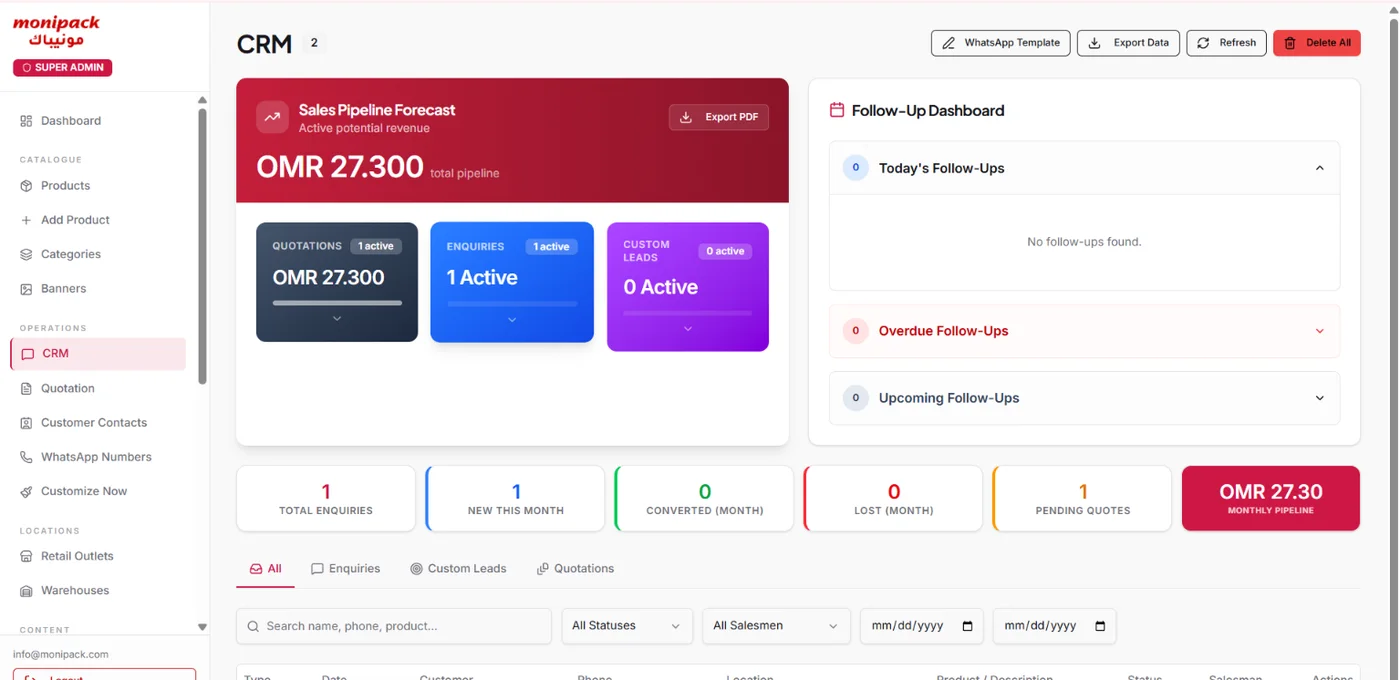
Dashboard · Step 6/6
Close, with a reason
Every inquiry ends as converted or not, with the reason recorded. Larger deals continue in the separate monipack CRM, where the sales team tracks them to the end.
A catalogue built for trade buyers
Most product cards show a photo and a price. Monipack's carry what a trade buyer actually checks: a unique part number, brand, size and colour, the selling unit, pieces per carton, an optional GTIN, availability, and prices for each unit when the business chooses to show them. Products can be flagged as Featured, Best Seller, New Arrival or Customizable, and grouped into promotional collections for the home page.
Discovery is built for speed. Search works across names and part numbers, categories and collections filter the range, and listings load in pages so even a large catalogue stays quick. Every product has its own link, so customers can share it and search engines can find it.
For anything outside the catalogue, a custom request journey collects contact details, requirements, quantities, notes and reference images. Each submission arrives in the dashboard as a lead the team can act on. Around the catalogue sit the pages that build trust: retail outlets, warehouses, careers, a blog, and published privacy and terms pages. Reviews go through moderation before they appear.
One dashboard for the business
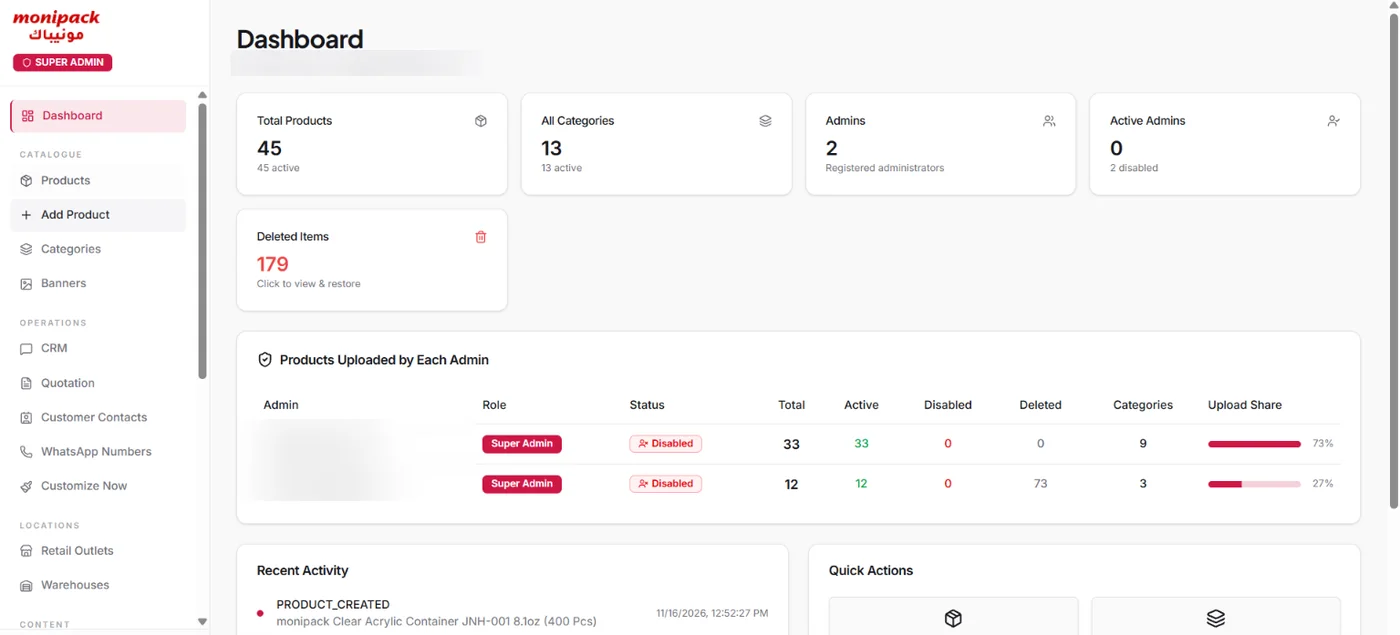
Behind the storefront is a secure dashboard where Monipack runs the platform themselves, without calling a developer.
- Catalogue: products, images, categories, availability, promotional flags and bulk import for authorised managers.
- Pricing: selling prices for each unit, with internal cost prices kept private and separate from anything the public sees.
- Content: banners, announcements, home page sections, collections, blog posts, popups, outlets, warehouses, careers, social links and WhatsApp contacts.
- Sales: inquiries, custom leads, quotations with PDF export, follow-ups and conversion reasons.
- Reporting: product views, inquiries, quotation activity, PDF downloads and WhatsApp interactions, with Google Analytics and a custom cookie-consent banner.
Two roles keep it safe. The Super Admin controls everything. A product-entry Admin can add products but can't edit submitted products or open the rest of the system. That rule is enforced by the server itself, not just by hiding menu items.
Connected to the monipack CRM
The storefront and its dashboard handle what customers ask for online. The sales team works in a separate CRM that Wahj Growth also built, where every enquiry from phone, WhatsApp, the website or a walk-in is assigned, quoted and followed to a result. Read the monipack CRM case study.
Security by design
A platform that holds pricing and customer data needs more than a password screen. Logins use hashed passwords and protected sessions, repeated failed attempts are throttled, administrative APIs reject anyone who isn't authorised, and the owner can see active sessions and sign people out. Uploads are validated, and an audit log records important changes.
Fast, findable and mobile
The storefront uses code splitting, compressed responses, caching, database indexes, paged listings and optimised media: WebP images in several sizes, lazy loading, and video that streams with generated posters. It works on phones with responsive layouts, touch-friendly controls and forms that fit small screens. Desktop and mobile catalogue checks passed at launch, with no script errors or sideways scrolling.
For search engines, product links and SEO information are delivered in the page itself, not only after JavaScript runs. That includes canonical URLs, a sitemap index with product modification dates, product structured data and social sharing images. This makes the site fully crawlable; rankings take time and are measured separately.
Problems we solved
Tap a card to see how we handled it.
Moving to new hosting without losing a thing
Part of the project was moving the live platform to independently run hosting, while keeping the same domain and every product URL, and without disturbing other systems already running alongside it. Records and media were moved, compared and checked before the switch. The old deployment was retired first so customers would never receive duplicate notifications, and temporary access used for the move was removed afterwards.
Verified at the migration checkpoint. These describe the move, not sales performance.
Under the hood
Experience
- React 19
- TypeScript
- Tailwind CSS 4
- Radix UI
- PWA
Server and data
- Express 5
- PostgreSQL
- Drizzle ORM
- TanStack Query
Media and documents
- Sharp (WebP)
- FFmpeg posters
- jsPDF quotations
Messaging
- Email (Resend)
- Web push
- WhatsApp workflows
What changed
Monipack now has one connected platform: a storefront where customers find products and explain what they need, and a dashboard and CRM where every inquiry becomes a quotation with a follow-up and a clear outcome. The next step is measuring results over time, such as inquiry-to-quotation rate, quotation turnaround and organic search traffic, and publishing them here.
Wahj Growth
Three lessons from this build
- Design the final action around how the business really sells. For Monipack that is a quotation, not a checkout.
- Treat staff access as an authorization problem: restrictions belong on the server, not only in the menu.
- Be honest in the interface: a product on screen is not guaranteed stock, a final price or a confirmed order.
Designed and built by Wahj Growth
Have a sales process that doesn't fit a template?
Tell us how you sell today. We'll design the platform around it.