- Insights
- E-invoicing
- Updated
- 3 min read
Oman e-invoicing deadline: Fawtara dates for 2027 and how to get ready
Decision 189/2026 made e-invoicing law in Oman. Businesses with supplies above OMR 5 million start on 1 April 2027 and all other VAT-registered businesses on 1 October 2027. Here's what that means and what to do now.
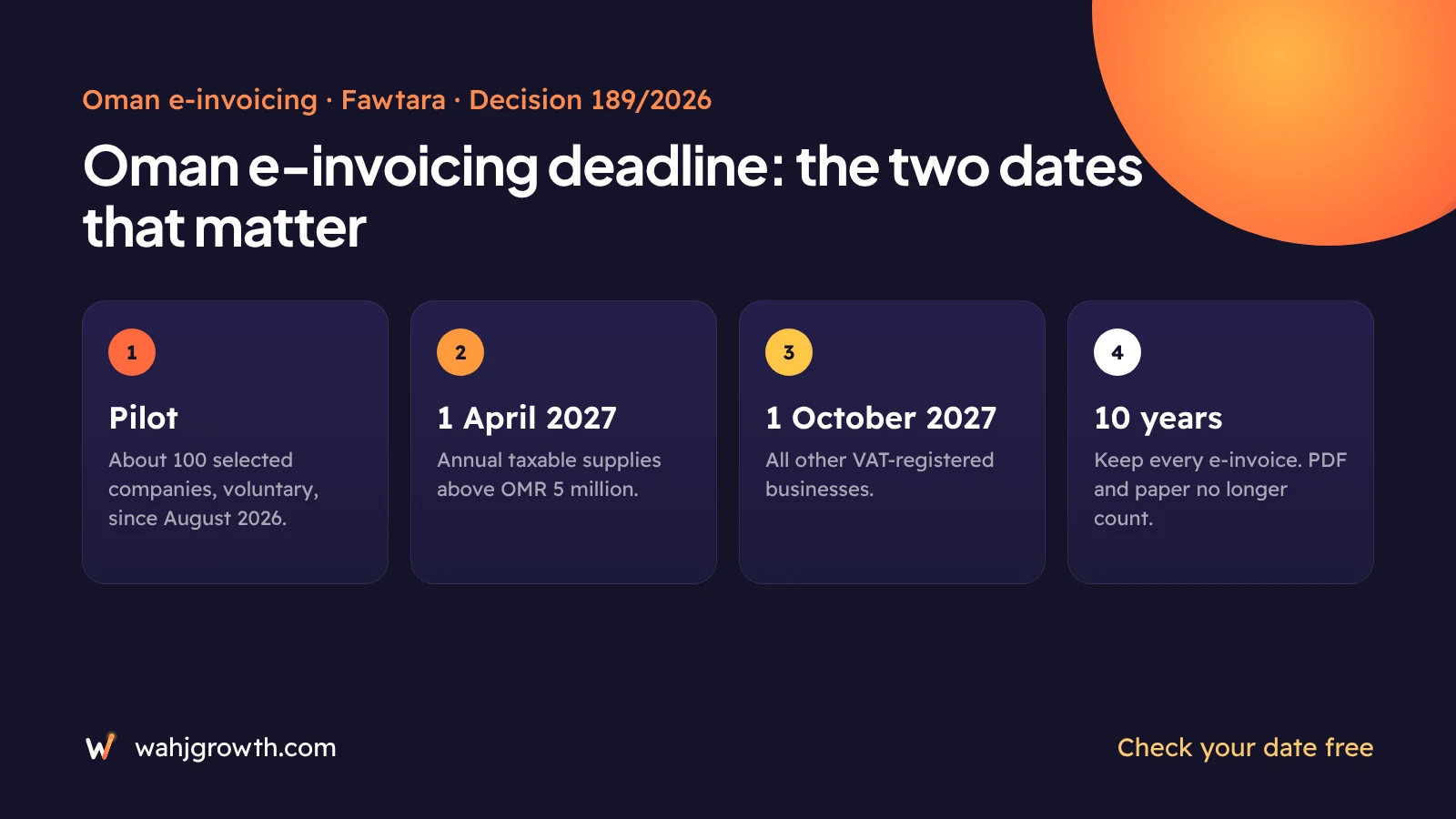
Short answer: e-invoicing is mandatory in Oman from 1 April 2027 if your annual taxable supplies are above OMR 5 million, and from 1 October 2027 for every other VAT-registered business. The dates are set by Tax Authority Decision No. 189/2026, which amended the Executive Regulations of the VAT Law. The programme is called Fawtara.
Check your exact date and get a plan in 2 minutes →
The Fawtara timeline
| Phase | Who | Date |
|---|---|---|
| Pilot (voluntary) | About 100 selected companies | Started August 2026 |
| Phase 1 | Taxable persons with annual supplies above OMR 5 million | 1 April 2027 |
| Phase 2 | All other VAT-registered taxable persons (OMR 5 million or less) | 1 October 2027 |
| Government entities | Government bodies | Proposed February 2028, not yet fixed in law |
Scope follows VAT registration, not where the company is established. If you are not registered for VAT in Oman, the mandate doesn't apply to you yet. Once you register, the October 2027 date applies.
The new decision replaced the earlier plan that had mandatory phases from August 2026. If you read older articles that mention August 2026, February 2027 or August 2027 as mandatory dates, they are out of date.
What changes for your invoices
- No more PDF or paper invoices for in-scope sales. The legal invoice becomes a structured electronic file in Oman's Peppol format, PINT OM (UBL XML).
- Sent through a licensed service provider. Oman uses a Peppol five-corner model. The Oman Tax Authority approves the providers and receives the invoice data.
- Validated by the tax platform. The invoice data is checked and reported to the Tax Authority, close to real time.
- You keep the records. Store e-invoices for 10 years. You also remain responsible for your system's security, continuity and data recovery.
What about fines?
Decision 189/2026 doesn't add a separate e-invoicing penalty table like the UAE's. But an invoice that isn't issued in the required form is still an invoicing failure under the VAT Law, which has its own penalties. Treat the dates as binding.
Your preparation checklist
- Confirm your phase. Use our free e-invoicing checker to see your date and countdown.
- Choose a provider from the Tax Authority's approved list well before your date. Onboarding and testing take weeks, not days.
- Review how you invoice today.
- Excel, Word or PDF invoicing has to move to software that can produce e-invoices.
- Accounting software: ask your vendor, in writing, which approved provider they connect to and from when.
- ERP or custom-built systems: plan an integration project that maps your invoice data to PINT OM and connects to your provider's API.
- Clean your customer data: legal names, addresses and VAT numbers (VATIN) for business customers.
- Set up receiving so supplier e-invoices reach your accounts team through your provider.
- Test with your provider before go-live, including credit notes and corrections.
- Plan storage for 10 years of e-invoices.
How we help
Wahj Growth is not an e-invoicing service provider. You choose a provider approved by the Oman Tax Authority. We connect your accounting system, ERP, CRM or custom software to that provider and automate the flow, so your team doesn't retype invoices. If you also invoice customers in the UAE, see our guide to UAE e-invoicing fines. Tell us how you invoice today and we'll explain what the integration involves.
Sources
- Peppol.nu: Decision 189/2026 sets 1 April and 1 October 2027
- Comarch: Oman revises the mandatory e-invoicing timeline
- Fonoa: Oman format, provider and archiving rules
- VAT IT: Oman's updated rollout, including government entities
- SNI Technology: Oman sets mandatory e-invoicing dates for 2027
General information based on published decisions as of 18 November 2026. It isn't tax advice. Confirm your position with your tax adviser.