- Insights
- E-invoicing
- Updated
- 4 min read
UAE e-invoicing fines 2026: what you pay if you miss the deadline
The UAE replaced its e-invoicing penalty table on 30 October 2026. Here are the new fines under Cabinet Decision No. 173 of 2026, who they apply to, the dates for each phase, and what to do this month.
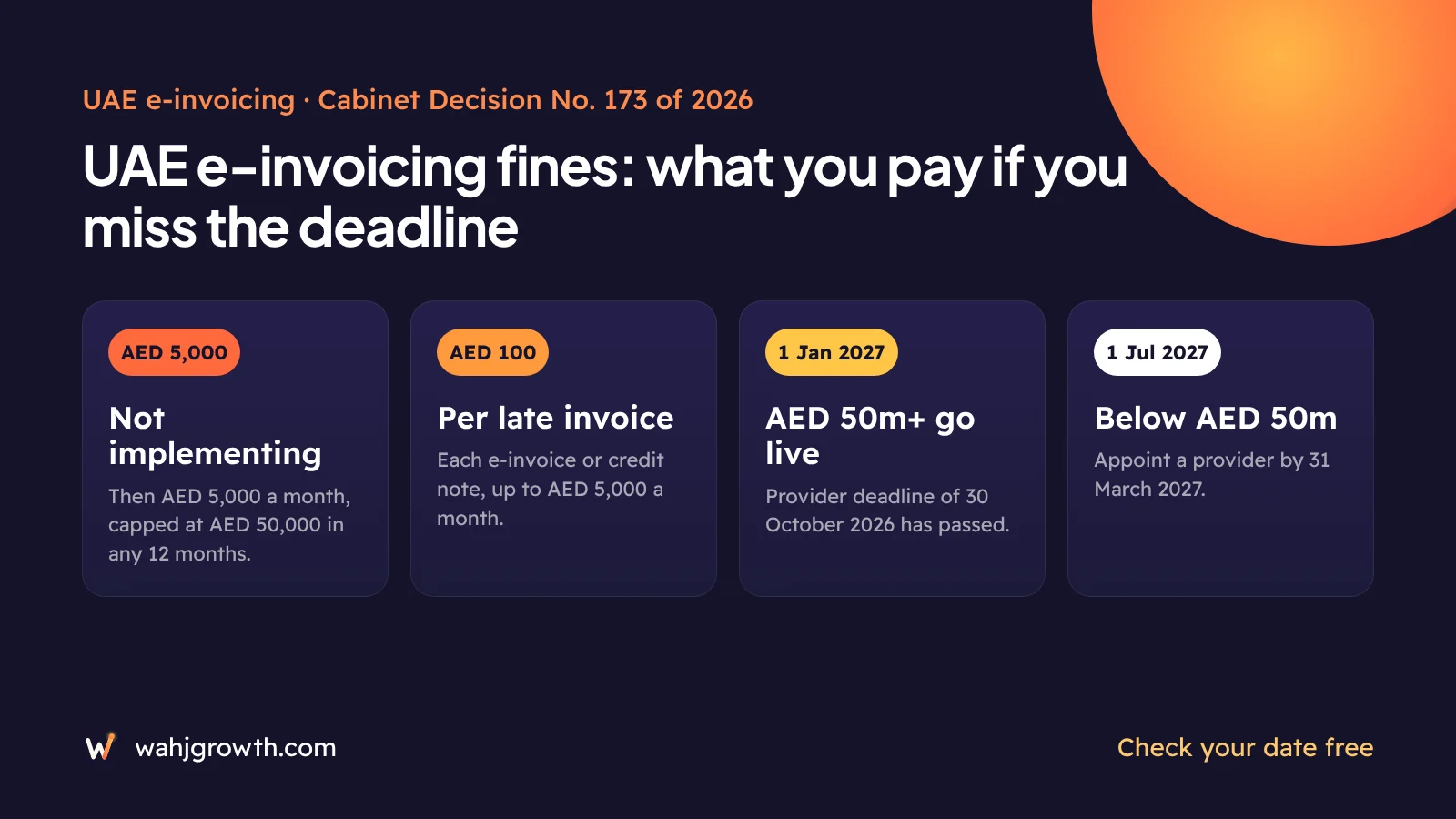
Short answer: if your UAE business doesn't implement e-invoicing on time, the fine is AED 5,000, then AED 5,000 for every month it continues, up to AED 50,000 in any 12 months. Each e-invoice or credit note you don't issue and send on time costs AED 100, up to AED 5,000 a month. These amounts come from Cabinet Decision No. 173 of 2026, which the Ministry of Finance announced on 30 October 2026. It replaced the earlier penalty table, Cabinet Decision No. 106 of 2025.
Check your exact deadline and fines in 2 minutes →
The new fines at a glance
| Violation | Fine |
|---|---|
| Not implementing the e-invoicing system on time, including not appointing an accredited service provider (ASP) by your deadline | AED 5,000, then AED 5,000 for each month or part of a month it continues, capped at AED 50,000 in any 12 consecutive months |
| Not issuing and sending an e-invoice on time | AED 100 per invoice, capped at AED 5,000 a month |
| Not issuing and sending an electronic credit note on time | AED 100 per credit note, capped at AED 5,000 a month |
| Not telling your provider about changes to your registration data | AED 250 per day, capped at AED 5,000 a month |
The fines apply to the business that should have issued or received the e-invoice. The UAE system works on a five-corner Peppol model, so buyers also need a provider to receive e-invoices, not just suppliers to send them.
Who must use e-invoicing, and when
| Who | Appoint a provider by | Mandatory from |
|---|---|---|
| Businesses with annual revenue of AED 50 million or more | 30 October 2026 (has passed) | 1 January 2027 |
| Businesses with revenue below AED 50 million | 31 March 2027 | 1 July 2027 |
| Government entities | 31 March 2027 | 1 October 2027 |
Revenue means your total annual revenue, including sales to consumers, not just B2B sales. The mandate covers business-to-business and business-to-government invoices. Sales only to consumers (B2C) are outside the mandate for now.
The Ministry of Finance originally set 31 July 2026 as the provider deadline for large businesses and later moved it to 30 October 2026. The go-live date of 1 January 2027 did not move.
What changed in October 2026
Two decisions changed the rules in October:
- Ministerial Decision No. 197 of 2026 (announced 19 October) excludes invoices between members of the same VAT tax group for two years from 1 January 2027. Invoices to anyone outside your group still follow your normal date.
- Cabinet Decision No. 173 of 2026 (announced 30 October) set the penalty table above, replacing the 2025 table.
A PDF invoice won't count
After your go-live date, a PDF, a Word document or a printed invoice is no longer the legal tax invoice for in-scope sales. The invoice has to be a structured electronic file in the UAE's Peppol format (PINT AE), sent through an accredited service provider. The Ministry of Finance publishes the list of pre-approved providers. You must still issue an electronic tax invoice even if your buyer isn't ready to receive one yet.
What to do this month
- Find your phase and dates. Use our free e-invoicing checker to see your deadline, countdown and plan.
- Appoint an accredited provider. If you are above AED 50 million and haven't appointed one, every month counts towards the fine.
- Check how your invoices are made today. Excel or Word invoicing won't work. Accounting software needs to be connected to a provider. ERP and custom-built systems need an integration.
- Clean your customer data. Legal names, addresses and tax registration numbers (TRN) for every business customer.
- Make sure you can receive e-invoices from suppliers, not only send them.
- Test before go-live, including credit notes and corrections.
How we help
Wahj Growth is not an e-invoicing service provider. You choose an accredited provider from the official list. We connect your accounting system, ERP, CRM or custom software to that provider and automate the flow, so your team doesn't retype invoices or handle rejections by hand. Tell us how you invoice today and we'll tell you what the integration involves.
Sources
- UAE Ministry of Finance: amendments to the e-invoicing decisions and the new provider deadline
- MEP Middle East: the 30 October deadline and Cabinet Decision No. 173 of 2026
- Comarch: UAE revises e-invoicing penalties
- The National: tax group exclusion from 1 January 2027
- Grant Thornton: Ministry of Finance e-invoicing guides
General information based on published decisions as of 18 November 2026. It isn't tax advice. Confirm your position with your tax adviser.